
Paving and paths in Wakefield
Sandstone flags, front garden paths, side returns and shed bases. The unglamorous half of a garden, and the half you walk on every single day of the year.
Why sandstone keeps winning
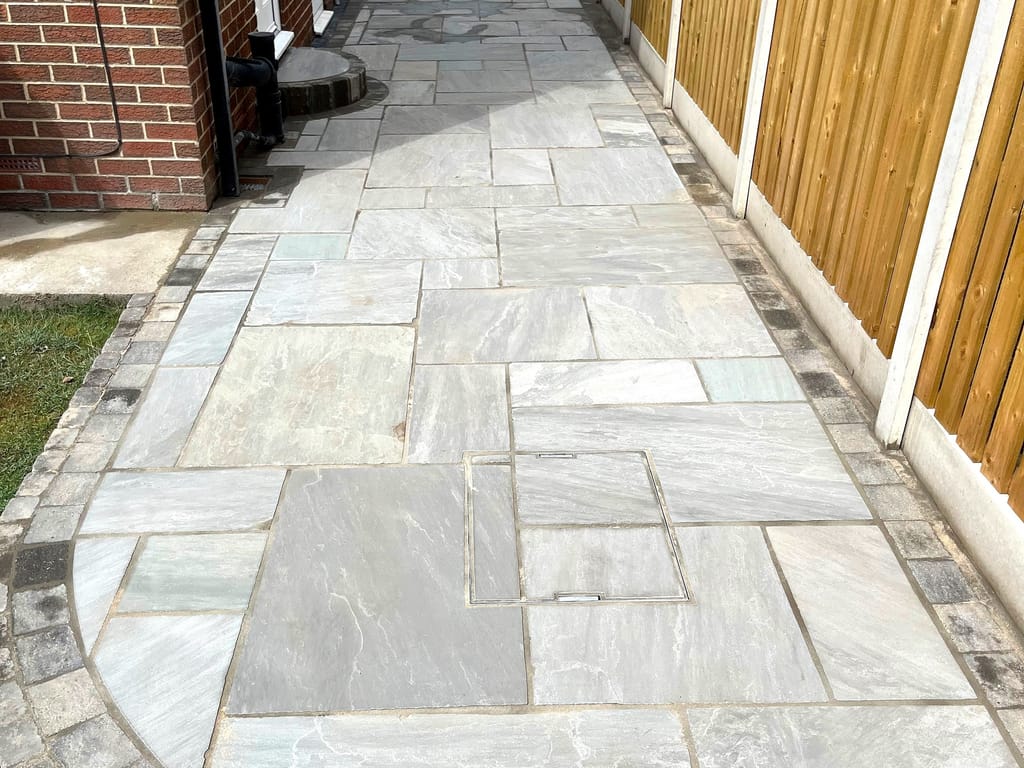
Whatever the project, sandstone tends to be the stone people come back to, and it is not fashion. It wears well, it takes the weather, it comes in a proper range of colours from pale buff through the greys and greens, and it looks like it belongs in a Yorkshire garden rather than shouting about itself. It suits a path, a small paved area, an edging detail or the base of a feature equally well, which means one material can tie a whole garden together instead of it looking like four different jobs bolted onto each other.
Width is the decision most people get wrong
Nearly everybody asks for a narrower path than they need, usually to protect the lawn, and then walks beside it for the next ten years. Before we dig anything we mark the run out with a line and get you to walk it. Two people side by side, the bin on its way to the front, a barrow, the mower. Measure the widest thing that will regularly go down it and give it a bit of room either side. It is a small amount of extra stone at the quote stage and it is the difference between a path you use and a mud stripe next to a path you avoid.
What stops a path falling apart at its edges
Edges. A path is a narrow strip, so proportionally it is nearly all edge, and it fails from the sides in. That is why every run we lay gets a proper restraint bedded on concrete and haunched, whether that is a charcoal block edge, a stone sett course or a kerb where the ground is dropping away. It holds the flags, it gives the mower something to run along, and it gives the whole path a line. Where a path meets a lawn, that edge is also what stops the grass creeping over the stone every summer.
Front paths, side returns and the awkward bits
The front path is the one visitors judge the house on, and it usually has to solve several problems at once: get from the gate to the door in a sensible line, meet the entrance step squarely, work with the front garden wall, and leave room for the bins. Side returns are the other job we get called out to constantly, that dark strip down the side of the house that is half mud, half broken slabs and permanently in shade. Paving it properly, with a fall taking water away from the wall rather than towards it, turns dead ground into the route you actually use.
Shed bases and hard standings
A shed sat on wet ground rots from the bearers up, and a shed sat on an out of level base never shuts properly again. So a base gets the same treatment as anything else: dug out, compacted stone, laid flat and true, with the paving taken a little wider than the shed on every side so the drip line from the roof is not landing on the joint. On a sloping garden the base has to be cut into the bank on the high side and held on the low side, which is where a course or two of walling comes in. The same build works for a greenhouse, a hot tub standing, a bin store or a spot for the motorbike.
Paving work sits alongside most of what we do. There are finished paths and paved areas in the gallery, the driveways page covers the front of the house, and you can see the towns we cover if you are outside Wakefield itself.
Questions we get asked about this
How wide does a path actually need to be?
Wider than most people first ask for. The test is not whether one person fits, it is whether the path does the job you will really use it for. If two of you walk down the garden together, a narrow path means somebody is on the grass, and after a winter of that there is a mud stripe alongside it. If the bin comes down it, or a barrow, or a mower, measure the widest thing you push and add a bit either side for your knuckles. We will walk it with you at the survey and mark it out with a line before anything is dug, because it is far easier to change your mind at that point than after the flags are down.
Can you put a shed base on a sloping garden?
Yes, and that is the usual reason people ring us about one. A slope means the base has to be cut into the bank on the high side and built up on the low side, and the built up edge needs holding, so it often gets a low retaining edge or a course or two of walling round it. Then it is a compacted stone base, laid flat and true, with the footprint taken a little past the shed on every side so the timber is not sat right on the edge and rain is not running straight off the roof into the joint. Get the level right and the shed door still shuts properly in five years, which is more than a lot of sheds manage.
Do the joints have to be pointed, or can they be left open?
On a path that gets real traffic, point them. An open joint fills with grit and seed, weeds root in it, and the flag next to it loses the support at its edge and starts to rock. Pointing it seals the top of the bed so water is running off the surface rather than soaking down under every flag. There are jointing compounds that brush in and set, and there is a traditional mortar joint struck by hand, and both have their place depending on the stone and the look you want. We will tell you which we would use on your job and why, rather than defaulting to whichever is quickest.
Get a price for your paving
Give us the postcode and a rough idea of the run, or send a photograph. We come out, mark it up with you on the ground and put a written price together. No deposit is asked for.